
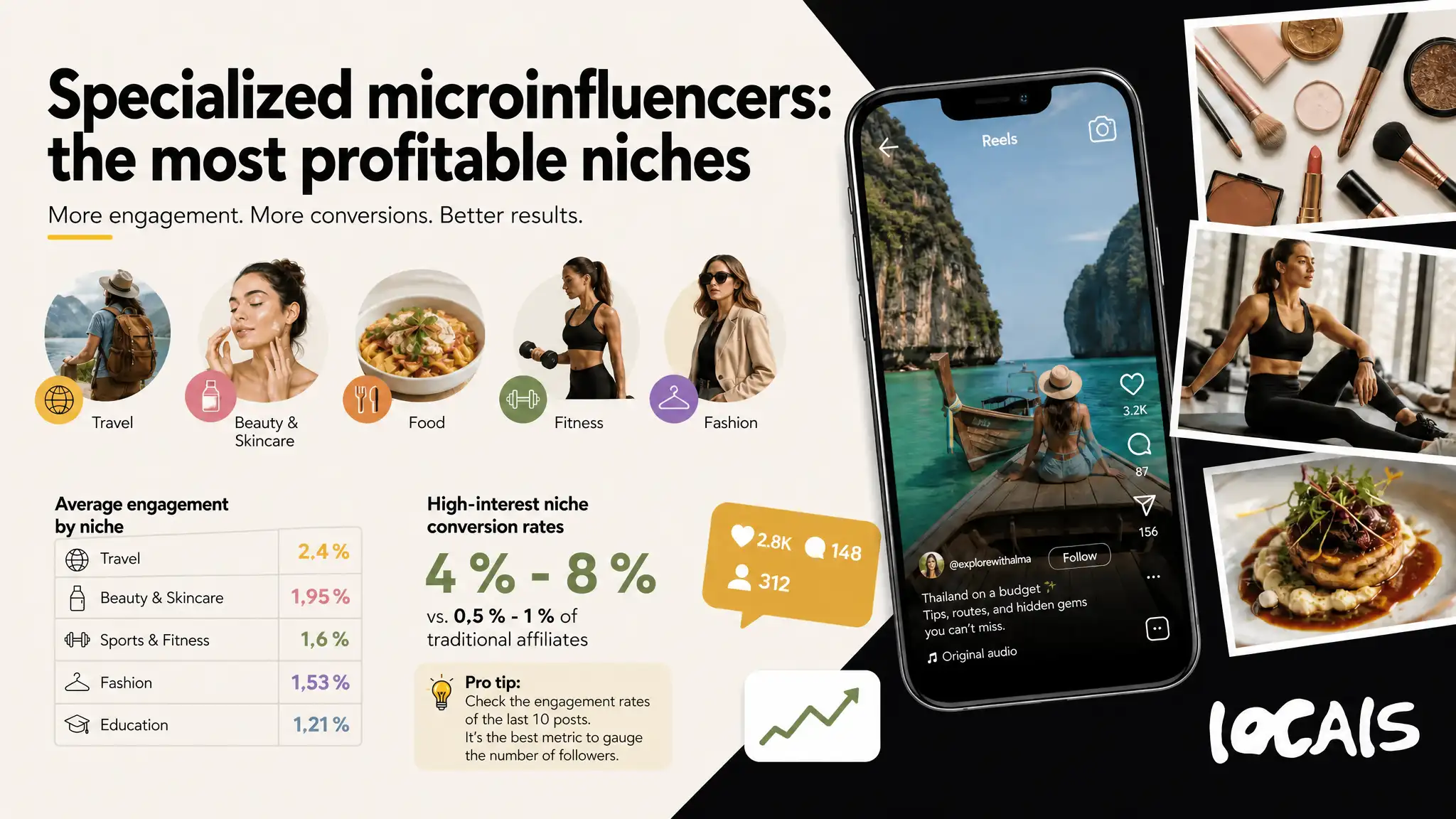
Travel, beauty and cosmetics, food, fitness and fashion are the sectors that get the highest return from specialist micro-influencers. The reason is concrete: their audiences are small but highly engaged, with interaction rates that double or triple those of macro-influencers, and conversion rates that in high-interest niches reach between 4% and 8%.
The Sectors with the Highest Engagement by Category
The level of audience response varies significantly by sector. According to data gathered by Puro Marketing, the sectors with the highest average interaction rate in influencer marketing campaigns are these:
| Sector | Average engagement rate |
|---|---|
| Travel and tourism | 2.4% |
| Beauty and cosmetics | 1.95% |
| Sport and fitness | 1.6% |
| Fashion | 1.53% |
| Education | 1.21% |
These figures are the channel average, but specialist micro-influencers within each category systematically beat it, because their audience is made up of people who chose to follow them out of a very specific interest.
Why Do Micro-influencers Convert Better than Digital Celebrities?
The difference is not reach, it is proximity. A creator with 15,000 followers around market-fresh cooking has a community that sees them as a peer with judgement, not as a distant aspirational figure. That perception reduces purchase friction.
The niche creator benchmarks for 2026 show that creators with highly engaged audiences reach conversion rates of between 4% and 8%, against the 0.5% to 1% of traditional affiliates. That gap is the real economic argument behind the strategy.
💡 Professional tip: Before choosing a creator by follower count, check their interaction rate across their last 10 posts. A micro-influencer with 20,000 followers and 4% engagement delivers more active audience than one with 80,000 and 0.8%.
Which B2B Sectors Also Benefit from This Approach?
The advantage of micro-influencers is not limited to direct consumer goods. In professional environments, the equivalent profile is the expert with their own community: a cybersecurity professional with a newsletter of 8,000 subscribers, or a digital transformation consultant with an active presence on LinkedIn.
Sectors such as technology, professional health, finance and energy are adopting this model because their buying decision-makers do not respond to conventional advertising, but they do respond to a recommendation from someone they recognise as a peer. The cost per qualified impression is substantially lower than in traditional media, and the bond of trust it creates is hard to replicate with budget.
Sectors Where the Return Is Harder to Get
Not every sector works the same way. Categories where the content tends to be purely informational or heavily regulated meet more resistance: mass consumer banking, generic insurance or industrial products with no aspirational angle or active community generate low engagement even with specialist creators.
The determining factor is whether a pre-existing community consumes content out of genuine interest. Where that community already exists, the micro-influencer activates it. Where it does not, they cannot create it from scratch with a campaign.
For sectors with strict advertising regulation (health, finance) you also have to manage regulatory compliance of sponsored content properly, which adds a layer of operational complexity worth weighing up before scaling.
If your brand operates in one of the sectors with the most potential and you want to identify which specialist creators can activate your real audience, the brands section of Locals Club shows how the process works: from selecting the creator to measuring the result, in a single system.