
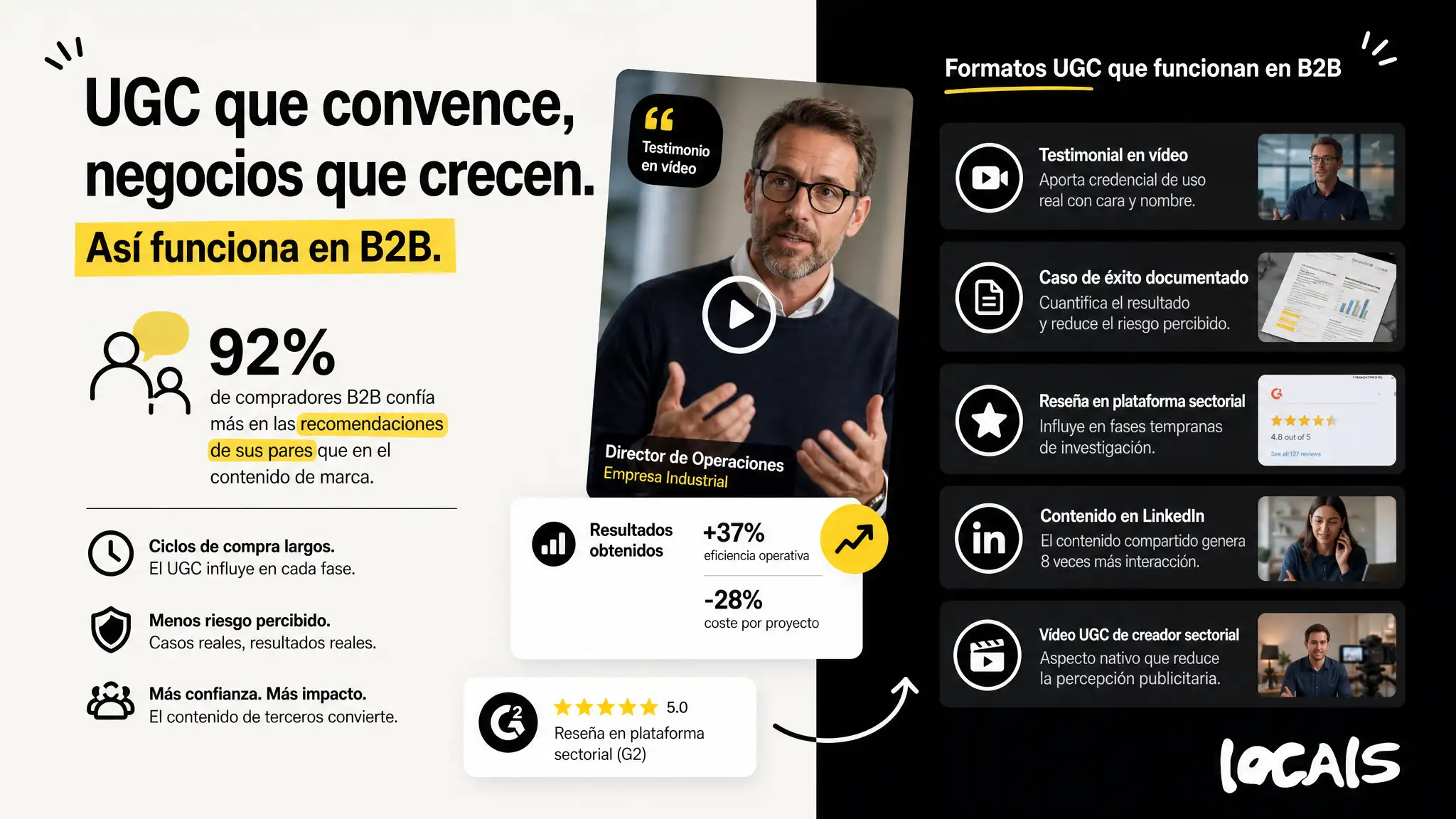
UGC does work in B2B and professional services environments, although the formats that produce results are different from those of mass consumer goods. Studies show that 92% of B2B buyers trust recommendations from their peers more than brand content, and that figure translates directly into the effectiveness of content generated by users or by creators with a sector profile.
Why Do B2B Buyers Trust Third-party Content More?
B2B buying cycles are long, involve several decision-makers and concentrate a high financial risk. In that context, content produced by the company itself carries a disadvantage from the outset: the buyer knows it is partial.
Modern B2B buyers carry out extensive research before speaking to any salesperson. They look for information in peer recommendations, industry forums and social media, not in product catalogues or sales decks. A testimonial from an operations director describing exactly the problem the buyer has today is worth more than any corporate white paper.
Reviews influence buyers in the awareness, consideration and decision phases, not only at the end of the process. That means UGC is not just a closing tool: it is a qualification asset that works across the whole funnel.
The Formats That Work in B2B and Services
The habitual mistake is importing mass consumer formats without adapting them. An unboxing or a short-form product review fits well in e-commerce; in professional services, the lever is different.
| UGC format | Where it fits in B2B | Why it works |
|---|---|---|
| Video testimonial | Websites, sales decks, LinkedIn | Provides proof of real use with a face and a name |
| Documented case study | Blog, commercial proposals | Quantifies the result and lowers perceived risk |
| Review on an industry platform | G2, Capterra, Google | Influences early research phases |
| Employee or customer content on LinkedIn | Organic feed and paid | Content shared by employees and customers generates 8 times more interaction than brand content |
| Sector creator UGC video | Paid social, YouTube | Native look that reduces the sense of advertising |
For the B2B and services segment, video testimonials and case studies are the most effective UGC format. The reason is simple: a professional buyer needs to see that someone with their same role, in their same kind of company, got a concrete result.
💡 Tip for professional services: Do not wait for the client to offer the testimonial. Design a delivery process that includes, as its last step, a short video interview. Most clients say yes when you ask at the moment of greatest satisfaction, right after they receive the result.
What Separates B2B UGC from Mass Consumer UGC?
Although UGC took off in B2C, it is gaining weight in B2B, where it provides proof of real use. Video case studies, detailed testimonials and software reviews become powerful validators that build trust and credibility. The difference is not in the psychological mechanism, which is the same, but in three operational factors:
- Identifiable authorship. In B2B, who is speaking matters as much as what they say. The name, the job title and the company are part of the argument, not a formatting detail.
- Editorial curation. A testimonial out of tune with the brand's positioning does more damage in professional services than in mass consumer goods. Editorial context does matter.
- Distribution channel. LinkedIn is the reference platform for B2B UGC; TikTok and Instagram work better when the goal is mass reach in consumer markets.
The Long Buying Cycle as an Advantage, Not a Brake
A common argument against UGC in B2B is that decision cycles are too slow to take advantage of the content's impact. It is the wrong argument.
95% of business customers are not actively looking for a product or service at any given moment, according to the 2024 Edelman and LinkedIn report. That means most of your target audience is in a passive phase: they will not respond to a direct-response ad, but they can be influenced by the case study of a peer solving their same problem. UGC works that latent state better than any other format, because it does not need active purchase intent to leave an impression.
When that decision-maker moves into an active phase, they already have a reference. And the references built before the buying cycle are the ones that weigh most in the final decision.
The Brands section at Locals Club sets out how companies from different sectors are activating this kind of content with creators from their own sector, with a contract, metrics and payment conditional on delivery from day one.