
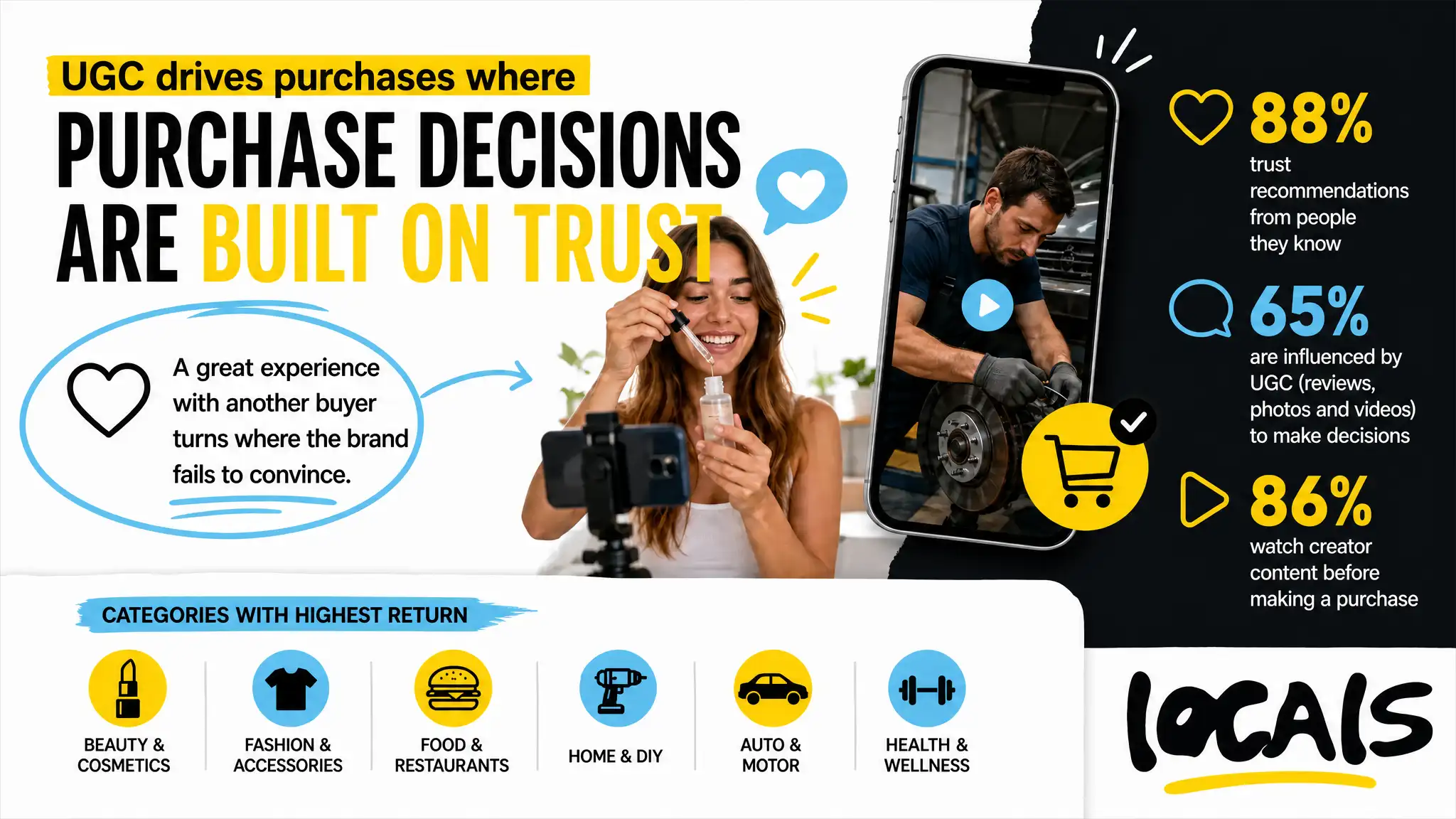
The sectors with the highest return on UGC advertising are those with an emotional or high-involvement purchase: beauty and cosmetics, fashion, food and restaurants, home and DIY, automotive, and health and wellbeing. In all of them the final decision depends on another buyer's experience, and that is where creator content converts once the brand ad no longer can.
What Makes a Sector Perform with UGC?
Three properties separate a high-return sector from one where creator content barely moves the needle.
The first is purchase involvement: the more money, risk or identity at stake, the more the opinion of someone real weighs against the brand's promise.
The second is the demonstrable component: a product that can be seen, tried or used on camera, a make-up product, a dish or a repair, gains from video what a spec sheet never conveys.
The third is recurrence: sectors with repeat purchases amortise a community of creators over months, not across a single launch. According to Nielsen, 88% of consumers trust recommendations from people they know above any other advertising format, and that advantage spikes exactly where the three properties meet.
The Highest-return Sectors, One by One
| Sector | Why it converts | Format that works |
|---|---|---|
| Beauty and cosmetics | Visible result and repeat purchase | Before/after video, routines |
| Fashion and accessories | Size and style validated by seeing others | Try-on and real photos by size |
| Food and restaurants | Craving and local trust | Dish video and filmed review |
| Home and DIY | Risky purchase that can be demonstrated | Assembly tutorial and real use |
| Automotive | Very loyal technical community | Installation and workshop test |
| Health and wellbeing | Sensitive decision that asks for proof | Testimonial and real follow-up |
The common denominator is social proof applied at the moment of deciding. 65% of global shoppers rely on user-generated content (ratings, photos and videos) to decide, and 86% look at creator content before buying, according to Bazaarvoice's Shopper Experience Index. In beauty, fashion and food that reliance is almost total, because the perceived risk (looking bad, spending on something that does not fit) dissolves once you see someone similar using it first.
Why Technical Sectors Are the Least Exploited Opportunity
The pattern repeats outside mass consumer goods, and that is where the return almost nobody captures sits. Automotive, DIY, professional services and B2B are verticals where UGC works just as well and very few brands work it systematically.
The reason is the same social proof, applied to a technical purchase: a mechanic showing a product in their workshop, or an installer documenting a fitting, is worth more than any catalogue, because the buyer in that sector trusts a peer's judgement before an advertiser's.
The effect is measurable. Skeepers documented that Woodbrass, a musical instrument retailer, lifted conversions by 23% after adding real customer videos to its product pages. The more niche and less saturated the sector, the wider that margin, because nobody is paying for that community's attention yet.
💡 Rule of thumb: if your buyer asks another customer before deciding, your sector is one of those that performs with UGC.
How to Measure Return Without Confusing Reach with Sales
A sector performs not when the video piles up views, but when the content lowers the cost of acquiring a customer. The metric that matters is cost per lead or per sale attributed to creator content, not the number of plays or the profile's follower count.
In fast-purchase verticals (beauty, food) it is measured on direct conversion and repeat purchase; in technical, long-cycle verticals (automotive, home, B2B) it is measured on assisted conversions and the value of the reusable assets, because a good installation video keeps selling months later. Picking the wrong metric is what makes a sector look like it "does not work" when what was being measured was the wrong thing.
If your company is in one of these sectors, or in a technical niche where nobody is using creators yet, the return depends on choosing the right people and measuring what actually converts. At Locals Club we build the whole campaign by sector, from casting to protected payment and measurement. Talk to the team and we will look at whether your case fits.