
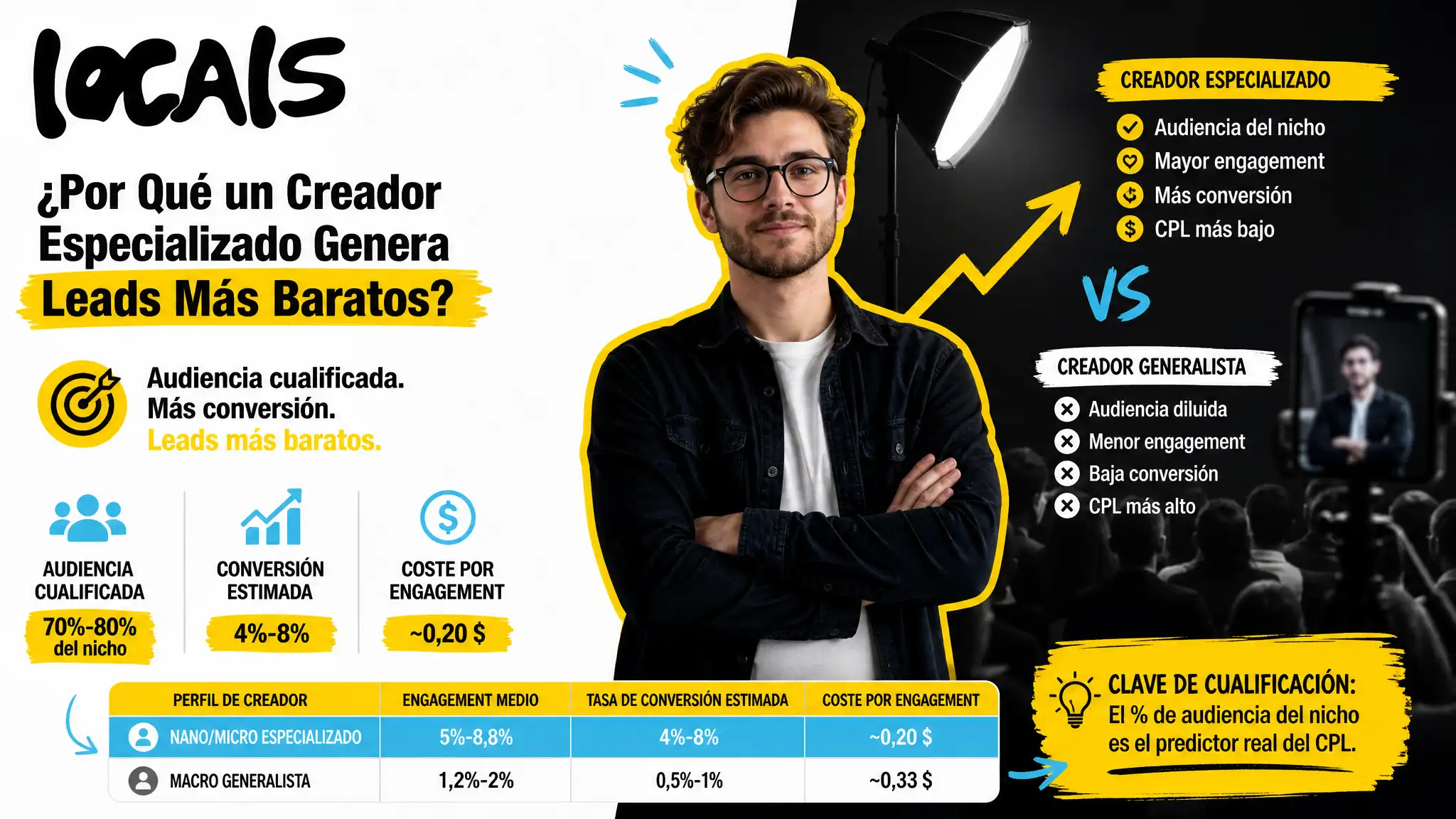
A creator specialising in your sector lowers the cost per lead because their audience arrives already qualified: they are professionals or active buyers in the niche, not casual viewers. That alignment between content and audience raises conversion rates and reduces the number of impressions needed to generate each lead, which brings the CPL down structurally.
How CPL Works in Creator Marketing
The cost per lead in a creator campaign depends on three variables: the cost of the collaboration, the real reach into the target audience and the rate at which that audience converts into leads.
A generalist creator with 500,000 followers can look efficient on cost per impression. The problem is that only a fraction of their audience belongs to the sector your brand needs. The result is high nominal reach and very low real conversion, which sends the effective CPL soaring.
A specialist creator with 15,000 or 30,000 followers can have an audience composition of 70-80% inside the niche. Every euro of the collaboration works on real potential buyers, not on generic mass.
How Much Does Conversion Improve with a Niche Creator?
Data from 2025 and 2026 points to notable differences between specialist and generalist profiles. According to Hamster Garage's Creator Commerce Benchmark Report 2026, creators with highly engaged niche audiences reach conversion rates of between 4% and 8%, against the 0.5% to 1% recorded by the average content affiliate.
In engagement terms, the difference is just as pronounced. According to Influencer Marketing Hub's State of Marketing, specialist nano-influencers reach engagement rates of 8.8%, against 1.21% for macro-influencers (more than 100,000 followers). Higher engagement on a more qualified audience translates directly into more leads per euro invested.
On cost per interaction, niche micro-influencers also come out ahead: according to Hubfluence's Influencer Marketing Benchmark Report 2026, the cost per engagement of a micro-creator is around $0.20, against $0.33 for macro profiles.
| Creator profile | Average engagement | Estimated conversion rate | Cost per engagement |
|---|---|---|---|
| Specialist nano/micro | 5%-8.8% | 4%-8% | ~$0.20 |
| Generalist macro | 1.2%-2% | 0.5%-1% | ~$0.33 |
💡 Qualification key: before setting a campaign budget, check what percentage of the creator's audience works or actively buys in your category. That figure, and not the follower count, is the real predictor of the CPL you will get.
Why Is the Celebrity Profile So Expensive per Lead?
Audience dilution is the mechanism that pushes up CPL on high-reach profiles. A celebrity or a generalist macro-influencer accumulates followers from multiple interests and demographics: their rate reflects that volume, but the brand pays for millions of impressions of which only a small proportion correspond to the real buyer persona.
The arithmetic consequence is direct: if only 3% of an audience of 2 million belongs to the target sector, the brand is effectively paying the cost of 2 million impressions to buy 60,000 relevant ones. A specialist creator with 60,000 followers from that same niche, at a far lower rate, delivers the same number of useful impressions at a fraction of the total cost.
On top of that, the trust the specialist creator has built with their community converts better: a recommendation from someone the sector recognises as a reference weighs more than one from a famous figure with no obvious link to the product.
Sector Specialisation Versus Platform Specialisation
There are two kinds of specialisation and they are not equivalent in CPL terms. A creator can be a specialist in a platform (for example, they have mastered the carousel format on LinkedIn) without having a concentrated sector audience. That improves the quality of the content but does not solve the audience qualification problem.
The specialisation that lowers CPL structurally is sector specialisation: an audience made up of professionals, decision-makers or active buyers in the sector the brand is targeting. Format and platform optimise distribution; the composition of the audience determines conversion.
The most efficient combination is a creator with a concentrated sector audience on the platform where that sector gathers, whether that is LinkedIn for B2B, YouTube for technical categories or Instagram for specialised consumer goods.
Which Variables Determine the Final CPL of a Creator Campaign?
The final CPL of a campaign is not set by the creator's profile alone. There are four factors the brand controls that shape the result:
| Variable | Impact on CPL | What to optimise |
|---|---|---|
| Percentage of niche audience | High | Ask for audience composition data before contracting |
| Content format | Medium | Formats that allow a direct CTA (video, carousel with link) |
| Traffic destination | High | A campaign-specific landing page, not the home page |
| Payment structure | Medium | Combine a fixed fee with a bonus per lead or conversion |
Performance-based payment, possible when the creator accepts a hybrid model (base fee plus commission per lead), aligns incentives and removes the risk of paying for impressions that do not convert.
If you work with digital creators specialising in your sector and want the contract, the delivery and the measurement in a single system, the Locals Club Brands section explains how the activation and escrowed payment process works.