
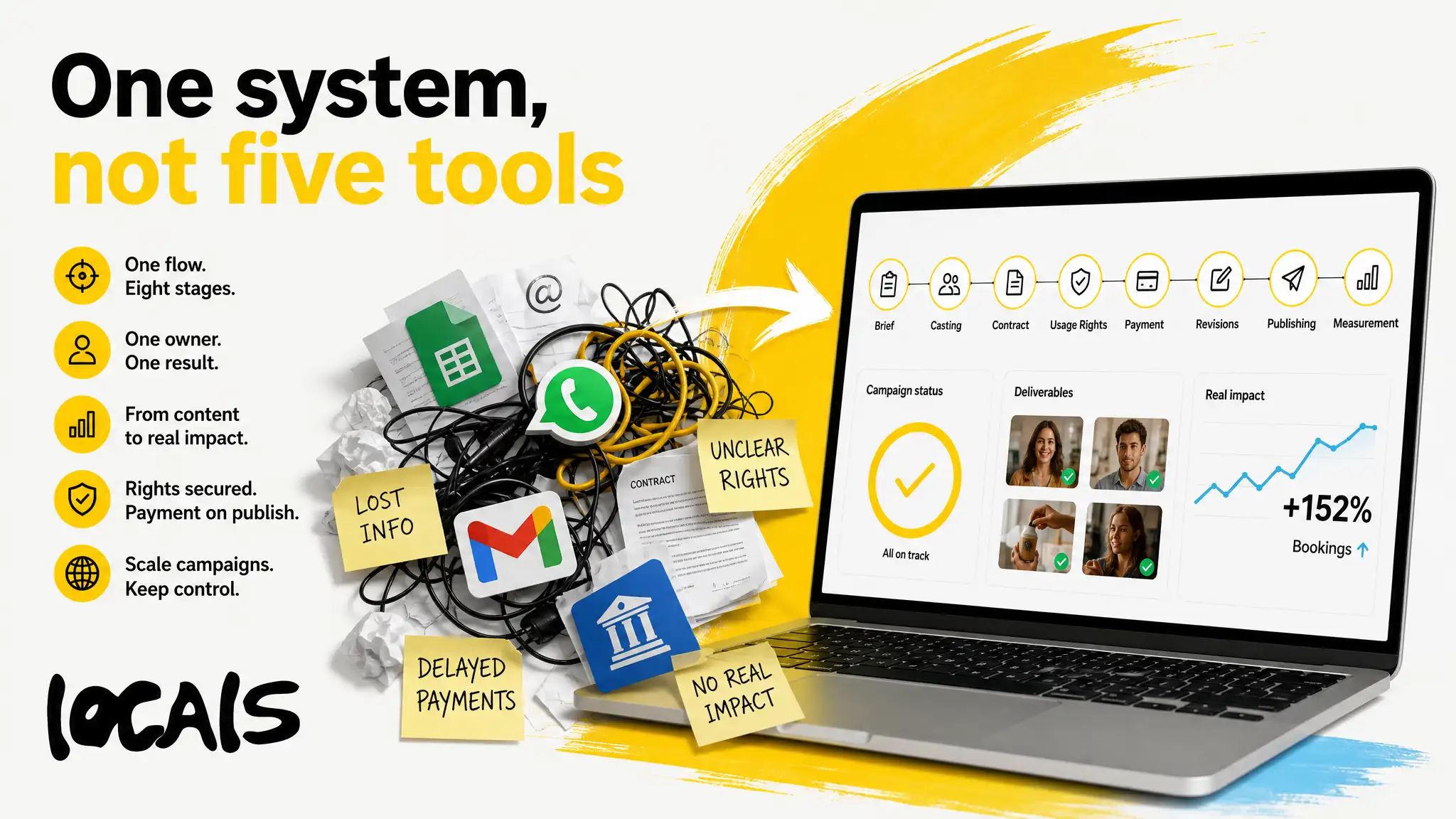
A UGC campaign runs through eight stages: brief, casting, contract, usage rights, payment, revisions, publishing and measurement. Spread across spreadsheets, email, WhatsApp and bank transfers, every handoff loses information, and at the end nobody can tell the client what the campaign produced. Brands and agencies need one system where all of it lives, with a person accountable for the result.
Where Fragmented Tools Break a Campaign
Most creator campaigns still run on a patchwork of tools: a spreadsheet of contacts, a DM thread per creator, a contract template in someone's inbox, a transfer from the finance team and a deck of screenshots at the end. Each tool works on its own. The campaign breaks in the gaps between them.
| Stage | With fragmented tools | With one system |
|---|---|---|
| Casting | Follower counts and DMs | Fit by sector and delivery history |
| Contract | Email template, rights unclear | Rights, territories and windows signed first |
| Payment | Transfer with no guarantee | Budget held, released on publication |
| Revisions | Versions lost across chats | Script, revisions and publishing in one thread |
| Measurement | Screenshots and views | Footfall, bookings, sign-ups and sales |
The costs are concrete. A piece goes live without the rights to reuse it in an ad. A creator delivers and waits weeks to be paid, so the next brief goes unanswered. A brand pays for content that never arrives. And the final report leads with views, because views are the only number anyone collected.
Why Is It Worse for Agencies?
A brand running one campaign can survive on spreadsheets for a while. An agency running campaigns for several clients at once multiplies every gap by the number of accounts. Rosters overlap, budgets get mixed, and the account manager spends the week chasing operations instead of working on strategy and on the client.
Margin is the second casualty. When cost lives in one file, markup in another and invoices in a third, nobody sees the profitability of a campaign line until the month is closed. By then it is too late to correct it.
The third risk is the client relationship itself. If the creator, the contract and the reporting all sit in tools the agency does not control, the agency's position depends on whoever holds those pieces.
This is why Locals Club runs agency work as a white-label operation: separate workspaces per account with independent budgets and rosters, cost and markup visible on every campaign line, and deliverables and reporting in the agency's own identity. The client stays the agency's.
What a UGC Management Platform Has to Cover
Not every tool that calls itself a creator platform solves the problem. Many are databases of profiles: they replace the spreadsheet and leave everything after it as manual as before. A platform worth moving to covers the whole cycle, from the first brief to the measured result:
- A structured brief with message, formats, dates and a fixed budget, agreed before anyone is contacted.
- Casting by fit to the sector and the market, scored on past delivery rather than on follower counts.
- Contracts that fix usage rights, territories and windows before anyone shoots.
- Escrowed payment: the budget is held when the creator is activated and released on publication, which protects the brand and the creator at the same time.
- Script, revisions and publishing in one thread, so the approved version is never in doubt.
- Measurement of what happens off-screen, agreed at the start, not reconstructed at the end.
💡 Tip from the Locals team: agree the one off-screen indicator (bookings, footfall, sign-ups or sales) and the expected volume of pieces before the first brief goes out. A campaign measured against a number chosen afterwards can always be made to look good, and that is exactly why clients stop trusting reports.
Is Software Enough, or Does a Campaign Need an Owner?
Centralising the tools solves the information problem. It does not solve the decision problem. Someone still has to choose which creators to activate, with which message and when, approve each piece before it goes out and answer the client when something moves.
That is the difference between self-service and a managed service. In self-service, the platform hands the brand or the agency a cleaner interface for the same work. At Locals Club, technology scans a network of 2,000+ creators across Spain, LATAM and the United States and scores sector fit; the decisions are made by a named person who owns the campaign, approves every piece and answers for the result. The AI proposes, people decide.
It also changes the starting speed. Because brief, contract and payment already live in one flow, a tailored plan arrives within 48 hours of the first conversation, instead of after weeks of chasing signatures and invoices.
What Running Campaigns in One System Looks Like at Scale
The case for one system is clearest when volume grows. For TEMU, Locals Club runs UGC across two countries at once, Spain and Argentina, with 50+ recurring creators a month. Calendars, briefs and reviews for both markets sit in the same system, and every piece has a double life: first in the creator's community, then amplified with paid.
Run that on spreadsheets and the operation needs a team per market just to keep track. Run it in one system and the team spends its time on the work that moves the result: choosing the right creators and judging the content.
If your brand runs UGC on scattered tools, this is how we work with brands; if you are an agency that wants to offer UGC under its own name without building a department, see the agency model.