
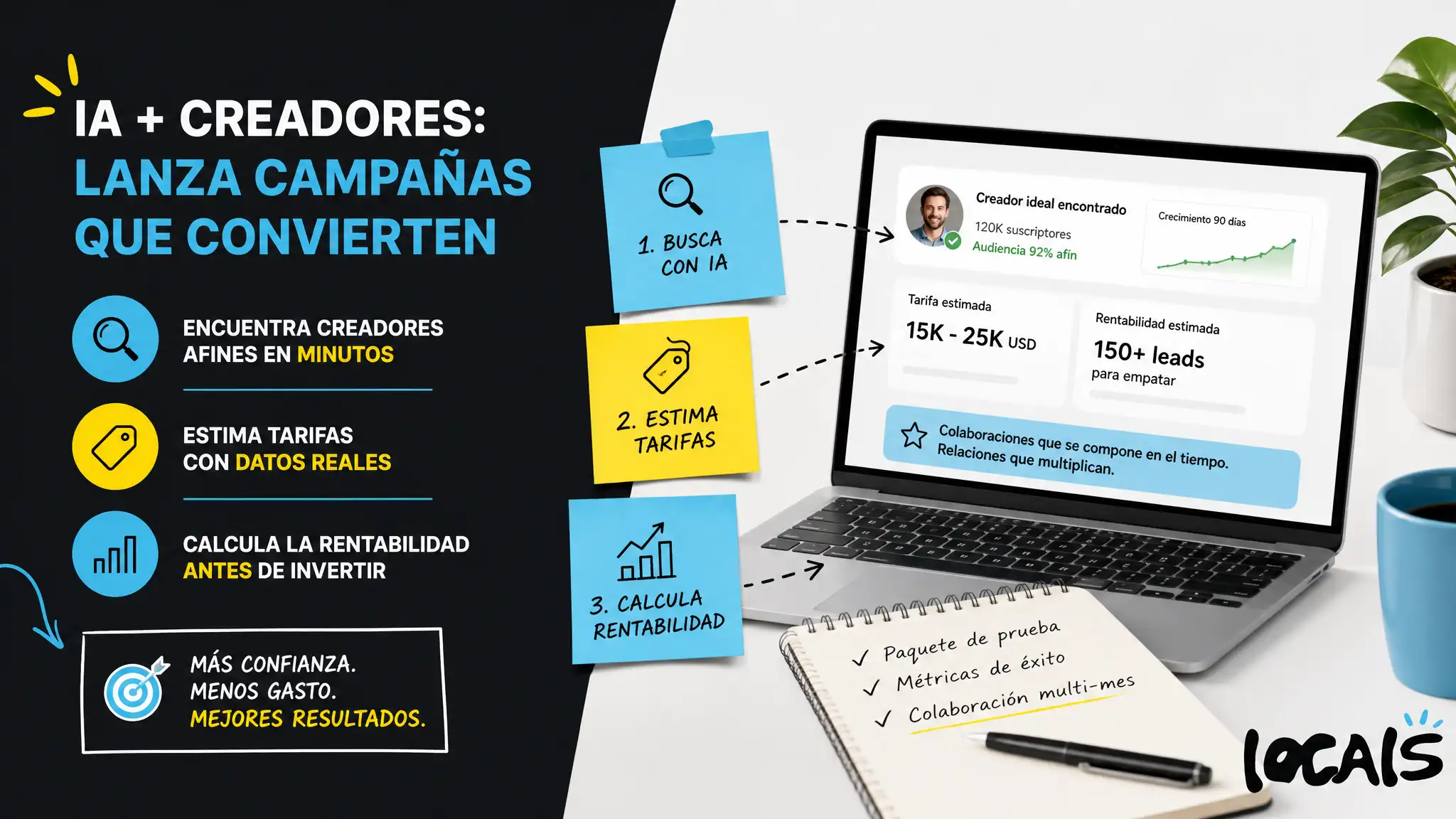
AI makes it possible to identify relevant creators, estimate their rate and draft the first contact email in a matter of minutes. The key is not automating the whole process, but combining that speed with human judgement: audience fit and a long-term orientation are the factors that make a creator collaboration more profitable than conventional paid ads.
Why Creators Compete with Paid Advertising
Creator collaborations work because they occupy the "trust gap" no ad can buy: the podcast, the YouTube channel or the newsletter your ideal customer consumes regularly. That attention is already earned; your brand only needs to enter that context naturally.
The data backs the shift. According to Socially Powerful, influencer marketing generates an average return of $5.78 for every dollar invested, against the $2 produced by paid advertising. And the sector's global market is projected to pass $23.6 billion in 2025, according to inBeat Agency, which reflects that brands no longer treat it as an experiment but as a structural channel.
This channel is not exclusive to direct-to-consumer commerce. B2B software and SaaS companies use it just as much when they structure creator relationships as long-term growth partnerships rather than one-off ad placements.
How to Find the Right Creator Before Spending
Before negotiating any agreement, the selection work decides whether the investment makes sense. The temptation is to go for big names; the mistake is paying for reach when what you need is fit.
The most profitable profile for a first campaign is the mid-sized creator (between 50,000 and 200,000 followers) with an audience close to your ideal customer and a rising trajectory. Micro-influencers in that range generate interaction rates of 5% to 7%, against the 1% or 2% of macro-influencers, according to Spiralytics. A growing channel with a highly aligned audience almost always outperforms a massive one with scattered followers.
To search, you do not need paid tools in the first phase. YouTube, TikTok and Instagram let you search directly by niche topic ("information security", "productivity for businesses") and filter by channel size. Note candidates whose content connects with the identity and aspirations of your ideal customer, not only with the product you sell.
💡 Signal to rule out: Avoid channels with a stagnant or falling audience even when they are large. Sustained subscriber growth indicates the creator is keeping their relevance and that their community is still expanding, two conditions that amplify the result of your campaign over several months.
The Scorecard for Selecting Creators
Once several candidates are identified, it is worth scoring them before contacting any of them. Subjective criteria ("I like their style") produce bad decisions; a three-dimension framework produces better ones:
| Dimension | What you measure | Why it matters |
|---|---|---|
| Audience size | Total followers or subscribers | Determines the potential reach of the message |
| Audience fit | Overlap between their followers and your ideal customer | The most predictive factor for cost per lead |
| Growth trajectory | Follower change over the last 90 days | Indicates sustained relevance and future profitability |
The optimal profile is high fit + high growth + mid size. An enormous creator with a scattered audience can cost ten times more and convert worse than a mid-sized one whose community is exactly your market. Before committing, ask for historical data from previous campaigns: views, click-through rate and conversions. If they do not have it or will not share it, that is a warning sign.
How AI Is Used at Each Stage of the Process
Artificial intelligence cuts manual work at three specific moments in the process, without replacing the judgement the work requires.
- Finding contact details. Tools such as Perplexity or Claude can locate a creator's business email, infer their manager or agency and draft a first collaboration email adapted to their content profile.
- Rate estimation. AI can infer indicative price ranges by platform and channel size, which helps you enter the negotiation with realistic references. A multi-asset package (video integration + social post + newsletter mention) for a creator with between 50,000 and 200,000 subscribers usually opens in a range of $15,000 to $25,000 in mature English-speaking markets.
- Calculating profitability up front. Before signing, AI can help you build the maths of the deal: if your current cost per lead is €100, a €15,000 deal needs 150 leads to break even. That figure gives context to whatever benchmarks the creator provides.
What AI does not do well is design the creative proposal. The most powerful counter-intuitive mechanism in creator marketing is letting the creator shape the message for their audience, because they know what tone and what format converts in their community. AI proposes the first contact; the creator shapes the offer.
Structuring the Collaboration So It Compounds Over Time
A first campaign with a creator is only useful if it validates the fit and lays the ground for a longer relationship. A single-video deal rarely reaps the benefit of accumulated trust; the collaborations that run for months are the ones that generate compounding results.
On the first call, there are three goals: agree a trial package, define shared success metrics and set out the structure of a multi-month collaboration if the results justify it. That framework reduces wasted spend and raises the odds of the campaign scaling sustainably.
At Locals Club we are building the platform that makes this process possible, and supervised: finding, contracting and managing digital creators in your sector with contract, delivery, escrowed payment and measurement in a single system, with AI proposing and people deciding. If you want to know when it is available or explore how it works for your case, take a look at the brands already working with us and get in touch.