
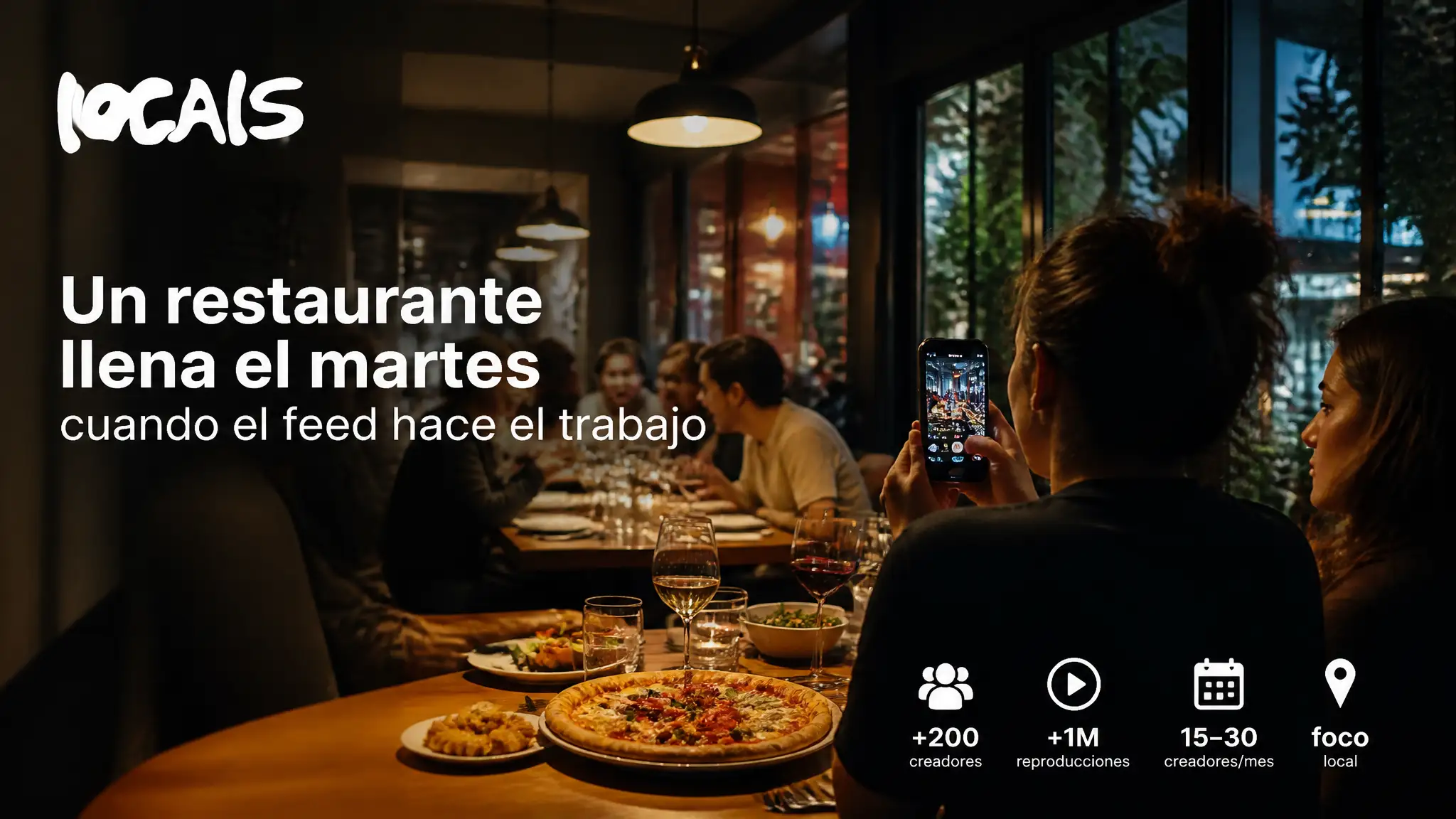
The problem of empty tables from Tuesday to Thursday is not price: it is that your restaurant does not appear in anyone's feed on those days. With Brands at Locals Club, a campaign of 15 to 30 local creators publishing content filmed on a weekday turns Tuesday into an occasion that exists in people's heads before they leave the house.
Why the Weekend Fills Itself and Tuesday Does Not
Friday and Saturday are destination decisions: the person has already decided to go out and is comparing places. Tuesday is an occasion decision: they have not decided anything yet. That difference changes everything.
For someone to go out on a Tuesday, it first has to cross their mind that going out on a Tuesday is an option. And that does not happen by inertia, it does not happen by walking past your door and it does not happen because your restaurant has good food. It happens if someone sees your place in the feed, with a Tuesday atmosphere and a visible price, before they have thought about eating out.
The real midweek competition is not the restaurant across the street. It is the supermarket, which solves the need to eat with no planning effort. You do not beat that on price or on speed. You beat it by making the idea of going out exist.
Why Does Midweek UGC Work Differently from Weekend UGC?
Every restaurant produces Saturday content: a full room, a festive atmosphere, a queue at the door. That content reinforces exactly the behaviour they already have: Saturday fills itself.
The content that moves covers from Tuesday to Thursday follows a different logic. It does not sell the place, it sells the occasion. "After-work without the noise", "a Tuesday dinner with no booking", "a set lunch that does not look like a set lunch": the dish is the pretext; what the brief asks of the creator is to make the plan exist.
💡 Production rule: the content has to be filmed on a Tuesday, with Tuesday light and with the room as it actually looks on a Tuesday. If the atmosphere in the video does not match what the person finds on arrival, trust breaks and the spontaneous UGC, the most valuable kind, never appears.
There is a second element most restaurants leave out: the price. Hiding the bill midweek, where the decision is functional rather than emotional, means losing the customer before they even consider booking. The creator should show it.
The Campaign Logic: Local Volume, Not One Big Influencer
Hiring a high-reach food influencer to come on a Saturday gives you one piece, one spike in views and no full Tuesday. The mechanic that does work is different on every axis:
| Usual approach | Midweek campaign |
|---|---|
| 1 big influencer, 1 visit | 15-30 local creators a month |
| Visit at the weekend | Content filmed between Tuesday and Thursday |
| Shows the place | Shows the occasion |
| Diffuse national reach | Density in the same neighbourhood, month after month |
| Metric: views | Metric: covers from Tuesday to Thursday |
The key is geographic density. Thirty creators from the same neighbourhood publishing in the same month is worth more than one national creator with ten times the followers. The goal is for someone to see your restaurant three times in two weeks in their feed. That produces the feeling that everyone is talking about the place; an isolated view produces nothing.
What we saw with Swiss Butter in Madrid illustrates it clearly: more than 200 invitations, more than 200 content pieces and more than a million views. The real result was not the number, it was the queue every night. And the most valuable effect was not the contracted content: it was the spontaneous UGC, published by customers who came because they saw the feed and posted their own piece without anyone asking them to. That content is the most credible, and the one that sustains the strategy.
How Do You Measure Whether the Campaign Is Filling Tables?
Views are the toll, not the result. Five metrics matter:
- Covers Tuesday to Thursday
- against the 4-6 weeks before the campaign
- Attributable bookings
- creator code, link in bio or asked at the door
- Spontaneous UGC
- pieces from customers nobody hired
- Searches for the venue name
- if they rise, discovery is working
- Midweek average ticket
- if it rises, you fill on desire, not discounts
When the average ticket rises at the same time as covers, the campaign is not just generating traffic, it is changing how the restaurant is perceived midweek. That is the state you are after: a Tuesday that stops being structurally empty.
If the restaurant has weekend covers and wants to carry that effect into weekdays, Brands is where the local food creators are, ready to run this strategy with a contract, verified delivery and metrics in a single system.