
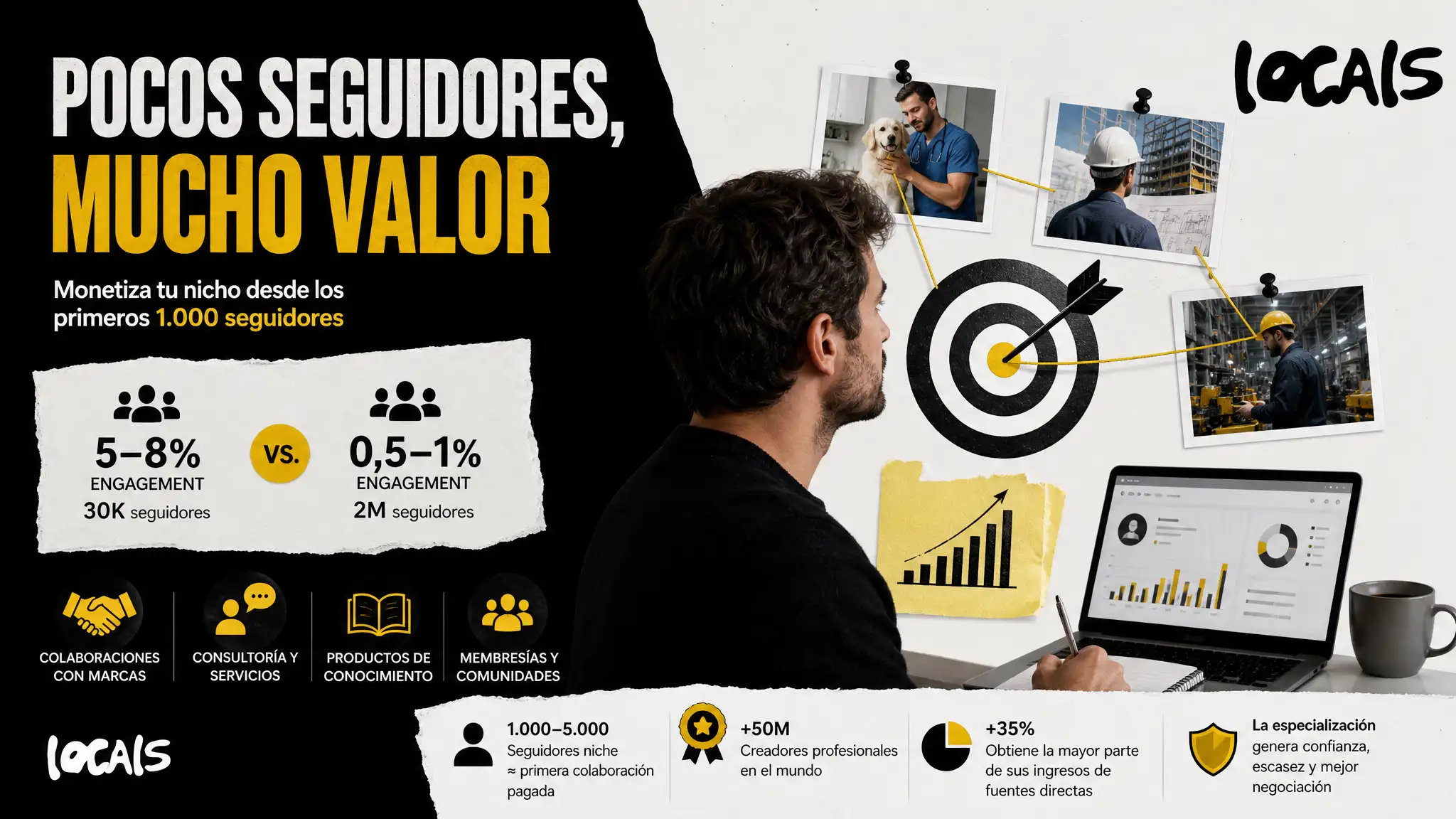
A creator specialising in a specific sector can monetise their profile from their first thousand followers. What matters is not the size of the audience but its precision: a community of 3,000 vets, architects or industrial machinery buyers is worth more to the brands in that sector than 300,000 generalist followers.
The Engagement Argument: Why a Small Audience Converts More
The main currency of influencer marketing is not reach, it is interaction. According to data gathered by MadMagna, a creator with 30,000 followers can reach engagement rates of 5% to 8%, while a profile with two million stays between 0.5% and 1%. It is not just a percentage difference: it means the small audience reads, comments and acts.
For a niche advertiser, that difference is decisive. A software company for clinics does not need to reach ten million people; it needs three thousand healthcare professionals to trust the recommendation they have just read.
Revenue Models for Specialist Creators
Specialisation opens up routes to monetisation that do not depend on follower volume or on platform algorithms.
Sponsored collaborations with companies in the sector. This is the most direct route. A brand that wants to reach a specific niche pays for access to that particular community, not for the total number of impressions. The price of a sponsored post rises when the creator can show that their audience matches that company's ideal customer exactly.
Consulting and professional services. The content works as a showcase for the creator's technical judgement. Someone who publishes rigorously about port logistics, employment law or clinical nutrition ends up receiving advisory requests from the people who follow them. The audience has already assessed them as an expert before making the first enquiry.
Knowledge products. Guides, short courses, templates or sector reports carry a justifiable price when the creator commands the niche. A highly specialised audience does not need to be large to sustain recurring sales.
Memberships and paid communities. Access to a network of professionals from the same sector has value in itself. A creator who organises that space can charge for membership, regardless of whether their public profile has ten thousand or a hundred thousand followers.
💡 Practical tip: Before approaching a brand, build a one-page document with your audience data: age range, professional sector, engagement rate and examples of conversations your posts have generated. That document is worth more in a negotiation than any follower count.
How Many Followers Do You Need to Start Charging?
There is no fixed threshold, but industry practice converges on between 1,000 and 5,000 well-segmented followers being enough for a first paid collaboration in a specialist niche. What sponsors assess before the number is the thematic consistency of the profile, the quality of the comments and the consistency of publishing.
SignalFire's Creator Economy 2025 report, cited by Randstad, estimates that more than 50 million people create content professionally worldwide and that over 35% of them already earn most of their income from direct sources, outside platform advertising. The trend points towards models where the creator controls the relationship with their audience and with sponsors.
Specialisation as a Negotiating Asset
The generalist creator competes on price with thousands of similar profiles. The creator specialising in a specific sector competes, in practice, with very few. That scarcity has a price.
According to ESIC, the competitive advantage of the small-community creator rests on three dimensions that mass profiles cannot replicate: high engagement, audience affinity and accumulated trust. All three are built over time; they are not bought with a paid media budget.
A creator who has spent 18 months publishing with technical judgement about a specific sector has something no advertising campaign can manufacture at once: the credibility of someone who has proved they know what they are talking about.
What Makes a Niche Creator Different from a Generalist Influencer
The difference is not only thematic. It is structural.
The generalist influencer depends on reach to monetise: the more followers, the more bargaining power with mass consumer brands. Their model scales with audience size and collapses if growth stops.
The specialist creator depends on relevance. Their audience does not need to grow without limit for the model to work; it needs to stay aligned with the sector. An audience of 8,000 HR professionals is a stable asset, not a declining metric.
That stability makes the niche creator a particularly valuable profile for sectors where trust takes time to build: health, finance, industrial technology, law or vocational training.
How to Price a Collaboration with No Clear Benchmarks
The lack of public rates in specialist niches is one of the biggest frictions for creators starting to monetise. With no industry standard, the tendency is to undervalue the work.
A practical starting point: calculate the cost per qualified impression, not the generic CPM. If one of your posts generates 400 interactions from professionals in the sector a brand is targeting, the value of those 400 interactions to that company is incomparably higher than 400 impressions on a generalist profile.
The negotiation improves when the creator can show concrete examples: a technical question that generated 30 replies in the comments, a recommendation that led to contact requests for the brand, or the percentage of their audience that works in the sponsor's target sector.