
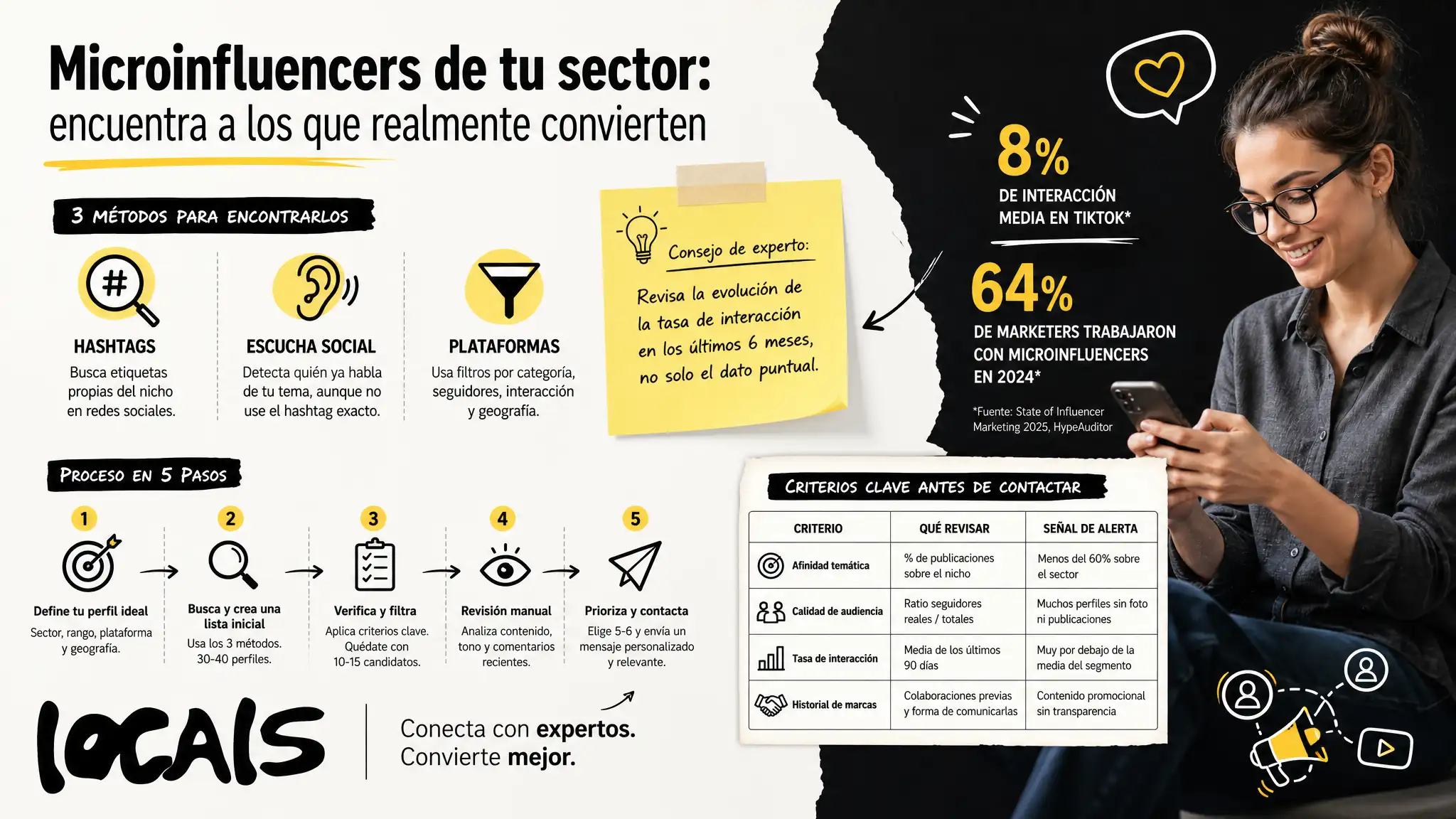
Micro-influencers in a specific sector are found by combining three routes: searching the hashtags that belong to the niche, social listening tools that detect who already talks about the topic, and discovery platforms with filters by category. The usual range is 10,000 to 100,000 followers, with interaction rates far above those of mass profiles.
Why Do Sector Micro-influencers Convert Better than Celebrities?
A niche micro-influencer does not have more audience, they have the right audience. Their followers arrived because they share a specific interest, not because the creator is famous in a broad sense. That difference completely changes the conversion equation.
According to HypeAuditor's State of Influencer Marketing 2025, micro-influencers on TikTok reach interaction rates of 8%, against the much lower average of profiles with millions of followers. 64% of marketing leads worked with micro-influencers in 2024 precisely because they offer higher interaction at a lower cost per action.
Sector specialisation adds another layer of value: the creator knows the vocabulary, the problems and the reference points of the sector. That translates into content the audience recognises as its own, not as advertising in disguise.
The Three Main Methods for Finding Them
Searching by sector hashtags is the most accessible starting point. It means identifying the five or ten hashtags used by professionals and enthusiasts in the category, searching them on Instagram, TikTok or LinkedIn depending on the sector, and reviewing which accounts publish frequently and get a good response from their community. The relevant profiles emerge within a few hours of systematic exploration.
Social listening goes a step further: instead of looking for who follows a tag, it detects who generates conversation about a topic even when they do not use the exact hashtag. Specialist tools track mentions, keywords and semantic contexts to surface creators who already talk about the category organically, before any brand has contacted them.
Creator discovery platforms offer combined filters: topic category, follower range, platform, interaction rate and geography. They let you export candidate lists and compare metrics without having to review profile by profile manually.
💡 Expert tip: Before contacting any creator, check how their interaction rate has evolved over the last six months, not just the figure at one moment. An account with sustained growth and authentic comments is worth more than one with an isolated spike followed by a drop.
Verification Criteria Before Making Contact
Finding candidates is only half the work. The other half is ruling out the ones that do not fit before investing time in the relationship.
Four criteria matter. Real topical affinity: the creator publishes about the category regularly, not occasionally or tangentially. Audience quality: the followers are real, active profiles, not bought or dormant accounts. Consistency of voice: the creator's tone is compatible with how the brand wants to be perceived. And collaboration history: checking whether they have worked with brands in the sector before and how they communicated it to their community.
A simple scoring table helps compare candidates against the same criteria, without first-impression bias:
| Criterion | What to review | Warning sign |
|---|---|---|
| Topical affinity | % of posts about the niche | Less than 60% about the sector |
| Audience quality | Ratio of real followers to total | Many profiles with no photo or posts |
| Interaction rate | Average over the last 90 days | Well below the segment average |
| Brand history | Previous collaborations and how they were communicated | Promotional content with no transparency |
What Separates a Sector Micro-influencer from a Generalist?
The difference is not only the follower count but the density of knowledge. A generalist creator with 50,000 followers posts about travel, food, fashion and technology in the same week. A sector micro-influencer with the same audience has spent months or years talking exclusively about, say, product photography, sports nutrition or industrial automation.
That density produces two concrete advantages. First, the audience is pre-selected: someone who follows a creator who only talks about one topic is already interested in that topic. Second, the creator has the judgement to assess the product or service, which makes their recommendation more credible and harder to argue with.
The B2B sector reflects this distinction well. A cybersecurity expert with 15,000 followers on LinkedIn generates more value for a software company than a generalist technology influencer with ten times the reach, because they speak to the exact decision-maker.
Platforms and Channels to Focus the Search On
The right channel depends on the sector. Not every niche has the same density of creators on every network:
| Sector | Priority channel | Usual format |
|---|---|---|
| Fashion, beauty, interiors | Instagram, TikTok | Short video, carousel |
| Technology, software, B2B | LinkedIn, YouTube | Article, video tutorial |
| Food and hospitality | Instagram, TikTok | Short video, story |
| Health and sport | Instagram, YouTube | Long video, review |
| Industry and construction | LinkedIn, YouTube | Use case, demonstration |
Searching in the channel where the sector's conversation already happens shortens discovery time and raises the odds that the candidates you find have active audiences in that same environment.
The Full Search Process, Step by Step
The process has five phases, best run in order, without skipping the verification in the middle.
First, define the ideal profile: sector, sub-sector, follower range, platform and geography. Without that filter up front, the search produces noise instead of useful candidates.
Second, run the search through the three methods described above (hashtags, social listening, discovery platform) and build an initial list of thirty or forty profiles without discarding any yet.
Third, apply the verification criteria to each profile and cut the list to ten or fifteen candidates that meet every minimum threshold.
Fourth, manually review the recent content of those shortlisted candidates: tone, frequency, the kind of comments they receive. No tool replaces this manual review.
Fifth, prioritise the best five or six and write a personalised first-contact message that shows you have read their content. A generic message has a far lower response rate than one referencing a specific post by the creator.