
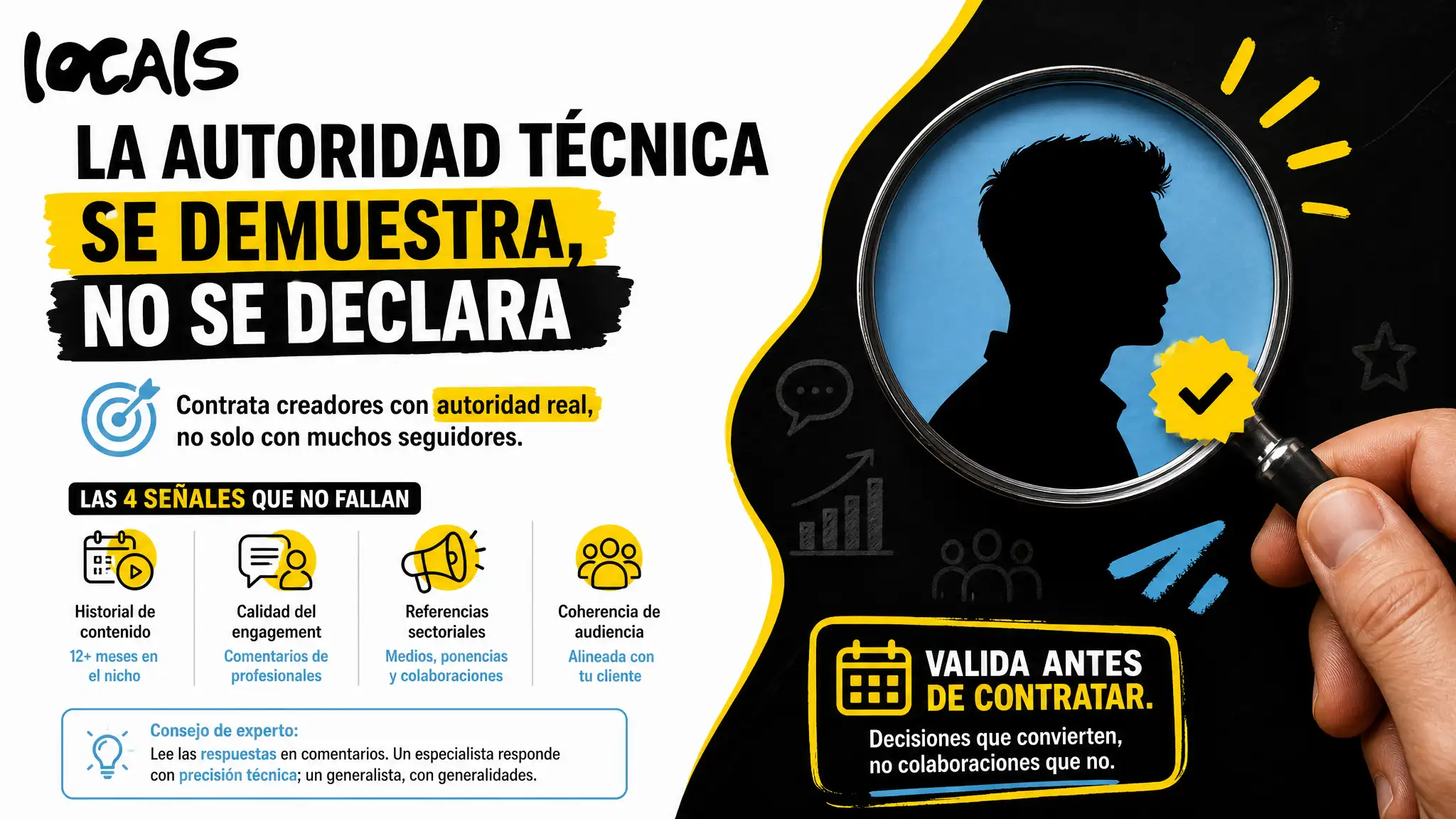
A creator's technical authority is validated with four concrete signals before signing anything: a history of specialist content in the niche, a quality of engagement that reflects a professional audience, verifiable references inside the sector, and demonstrable coherence between their real community and your target customer. A profile with many followers is not the same as a profile with authority.
The Four Signals of Technical Authority
Hiring a creator for their follower count is the most expensive mistake a brand makes. Technical authority does not live in the headline numbers; it lives in specificity and in the coherence between what the creator says, what they know and who listens to them.
These are the four signals a marketing team should assess before any hiring conversation:
| Signal | What to look at | Red flag |
|---|---|---|
| Content history | Posts in the niche with at least 12 months of continuity | New account with a recent change of topic |
| Engagement quality | Substantive comments from professional profiles in the sector | Mass likes with no comments, or generic ones |
| Sector references | Mentions in niche media, talks, collaborations with sector brands | Only self-reference in the bio |
| Audience coherence | Demographic and professional profile of followers aligned with your customer | Mass audience but geographically or demographically disconnected |
💡 Expert tip: Before reviewing metrics, read the replies the creator gives in comments. A specialist answers with technical precision; a generalist answers with generalities. That difference does not appear in any platform report.
What Separates the Specialist Creator from the Generalist?
Specialisation creates a form of credibility that mass reach cannot replicate. According to an analysis of strategic influencer marketing published by VPITV, a creator with authority in a specific niche beats the generalist when the campaign's goal is results-oriented, because their audience is already predisposed to listen in that specific context.
The practical distinction is simple: the specialist has a track record, not just a presence. They can show a consistent line of argument on a topic over time, and their community replies with technical questions, not only with emojis.
How Do You Verify That Their Audience Is Real and Relevant?
A real audience in a specialist niche leaves traces that an inflated audience cannot fake: technical debate in the comments, questions from professionals in the sector, and conversations that reflect real use of the product or service the creator is discussing.
Practical verification takes three steps:
- Review who comments, not how many: accounts belonging to sector professionals weigh more than generic accounts.
- Compare the engagement rate against the size of the account. The Influencer Economy Study by IAB Spain and Primetag confirms that niche creators with smaller communities show proportionally higher engagement rates than high-volume profiles.
- Ask the creator for their audience analytics directly, especially the professional and geographic breakdown, and compare them against your customer profile.
The Credibility That Does Not Show Up in the Metrics
There is a dimension of technical authority no analytics dashboard measures: reputation within the trade. A creator with real authority in a specialist sector usually has a presence beyond their own channels: they are cited in niche media, they have taken part as a speaker or contributor, or they are mentioned by other professionals in the same field.
Research on influencer credibility published in Revista ESIC Market identifies perceived expertise as one of the variables with the greatest impact on the audience's intention to act. That perceived expertise is not built with content alone: it is built with external signals of recognition in the sector.
The most direct check is a search for the creator's name combined with the name of the sector or the product category. If they appear in trade media or at professional events, the authority has roots outside their own channel. If they only appear on their own networks, the authority is, for now, self-proclaimed.
The Validation Process, Step by Step
Validating a creator's technical authority does not take months. With a structured process, the team can make an informed decision in less than a week:
- Week 1, days 1-2
- Review the last 12 months of posts in the niche
- Week 1, day 3
- Analyse engagement quality (who comments, what they ask)
- Week 1, day 4
- Search for external references in sector media and events
- Week 1, day 5
- Request audience analytics and compare with the customer profile
- Decision
- Move to a hiring conversation, or rule out before negotiating
This process separates the brands that build profitable relationships with creators from those that accumulate collaborations that do not convert. Technology can speed up steps one and two; steps three and four require human judgement.
When this validation process is already solved up front, brand teams can put their energy into strategy instead of screening. The brands section of Locals Club is designed for exactly that scenario: creators specialising in specific sectors, already validated, with contract, delivery and measurement in a single system.