
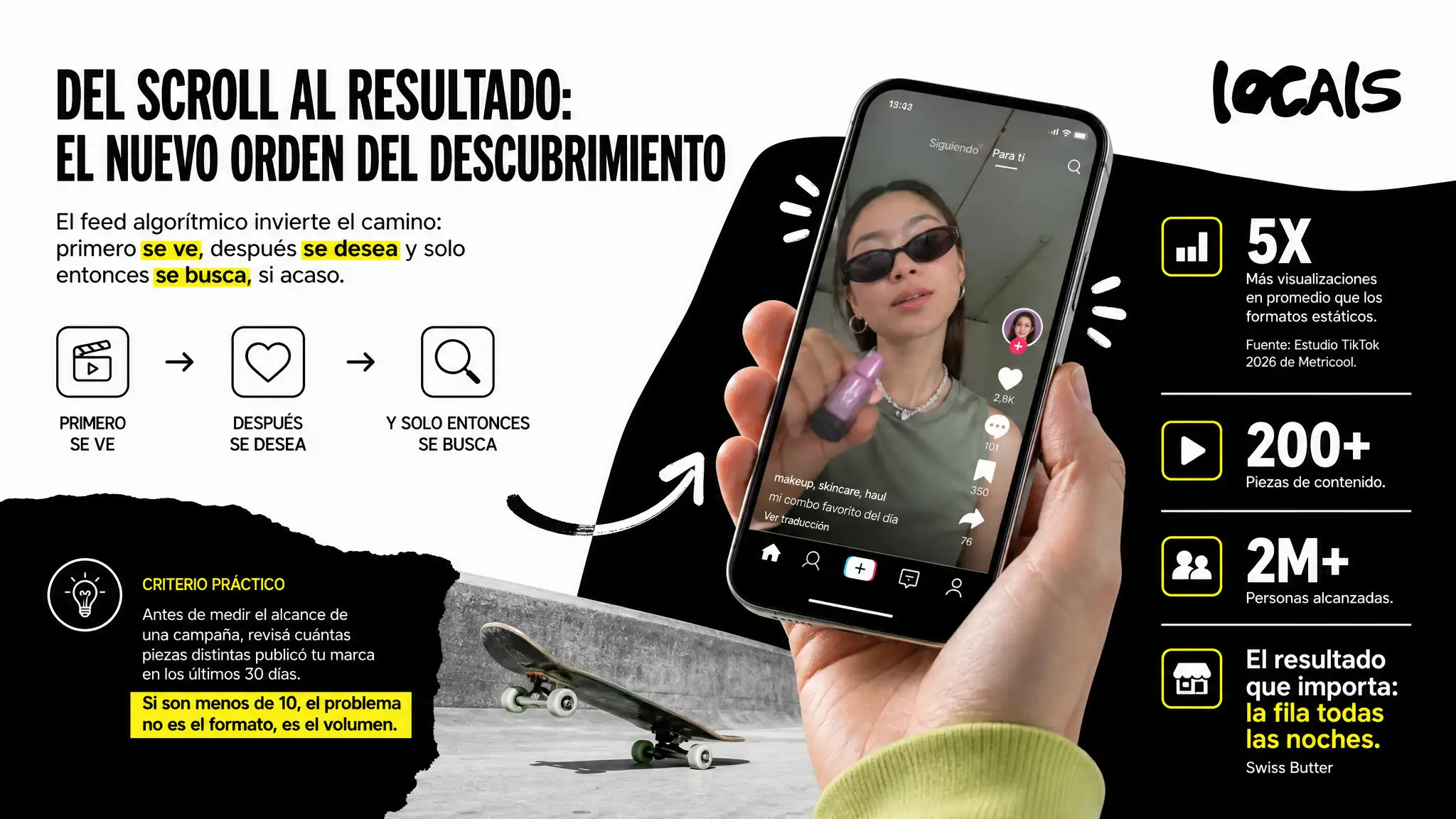
Short vertical video is no longer a format exclusive to social networks: it is the interface through which people discover, desire and only then search. Platforms such as Substack, Amazon, Sephora and Despegar have built algorithmic feeds of their own. For brands, the consequence is concrete: the unit of competition has stopped being the ad and has become the piece of content.
How the Algorithmic Feed Reached Platforms That Are Not Social Networks
The journey started, predictably, in Instagram Reels, YouTube Shorts and LinkedIn: social networks adopting short video segmented by interest to hold screen time.
What matters came next. Substack, a platform for newsletters and long-form text, introduced an infinite video feed to boost author discovery. Amazon and Mercado Libre integrated in-app content to stop working as simple catalogues and become engines of inspiration. Sephora added user-generated video reviews inside its own app, creating a cycle where purchase content feeds the next purchase. Despegar takes the phenomenon into travel with a short video feed that inspires the next destination before the user has thought of searching for it.
None of these platforms needed a feed. They all built one the same way, because the logic of discovery has moved.
The New Order: Desire First, Search Second
For two decades the model worked like this: intent, search, comparison, purchase. The algorithmic feed reverses that order. First you see, then you want, and only then do you search, if at all.
According to Metricool's TikTok Study 2026, which analysed more than 2.3 million posts, videos get on average five times more views than static formats on the same platform. The figure matters because it illustrates why short video took over as the preferred interface: the algorithm distributes it, the user consumes it and the cycle feeds itself.
For brands, the consequence is uncomfortable. When the entry point to the funnel is the scroll and not the search, the asset that matters most is not the media budget but the volume of authentic content circulating continuously. The algorithm does not reward the perfect piece. It rewards repetition and continuity.
💡 Practical test: Before measuring the reach of a campaign, check how many different pieces your brand published in the last 30 days. If the answer is fewer than ten, the problem is not the format, it is the volume.
Why the Influencer Logic Works Differently in an Algorithmic Feed
The influencer model was built on an assumption of scarcity: few voices with a lot of reach per piece. One activation, one post, one campaign, enough to make an impact.
The algorithmic feed ecosystem works on the opposite assumption. Attention is fragmented, the reach of each individual piece is unpredictable, and what accumulates results is not the biggest voice but the density of authentic content published at the same time by several sources.
The practical distinction between the two models can be summed up like this:
| Influencer | Content creator |
|---|---|
| High, predictable reach per piece | Variable, unpredictable reach per piece |
| One concentrated activation | Volume, repetition and continuity |
| Aspirational positioning | Constant presence in the feed |
| High investment, brand impact | Lower investment, performance impact |
| Result: desire in the moment | Result: accumulated awareness |
Betting the whole budget on a single piece from a large profile in an algorithmic discovery environment is the equivalent of buying an expensive lottery ticket. Thirty creators publishing over three months is a different strategy: it generates the volume the algorithm needs to distribute, and the repetition the user needs to act.
From Views to a Physical Result
Views are the toll, not the destination. This is the point most often lost when measuring content campaigns.
The Swiss Butter campaign described in the Locals Club materials illustrates it with concrete figures: more than 200 content pieces, more than a million views, more than two million people reached. But the result that mattered was a different one: the queue every night at the venue. When enough people see their feed talking about the same place for long enough, something happens that paid media can rarely generate: people go. And when they go, they post their own content, closing the cycle.
With Íkualo, the same logic applied to fintech produced more than 40,000 sign-ups in the first six months. With TEMU, authentic organic content acted first as social validation inside the creator's community and was then amplified with paid, reducing the risk of the paid investment because the social proof already existed before paying to distribute it.
The metric that separates a content campaign that broke out of the loop from one that only circulated inside it is always physical: visits, sign-ups or attributable sales. Views confirm you entered the ecosystem. Physical traffic confirms you left it for something real.
What This Environment Demands of a Brand
The structural change that algorithmic feeds on non-social platforms describe has concrete implications for any brand that wants to appear at the point where desire is now generated.
First, the vertical, authentic format is the minimum condition for existing in the ecosystem. A brand with no content circulating in that format simply does not appear at the moment the algorithm distributes desire.
Second, frequency beats perfection. One excellent piece published once does not compete with thirty genuine pieces published continuously. The algorithm accumulates engagement signals over time, not in an instant.
Third, proven organic content is the best input for paid. A piece that has already generated organic engagement carries social proof into the moment it is amplified. The best ad in this environment is the one that does not look like an ad.