
Articles · 6 min read
The Motor and Workshop Sector: One of the Most Powerful UGC Communities
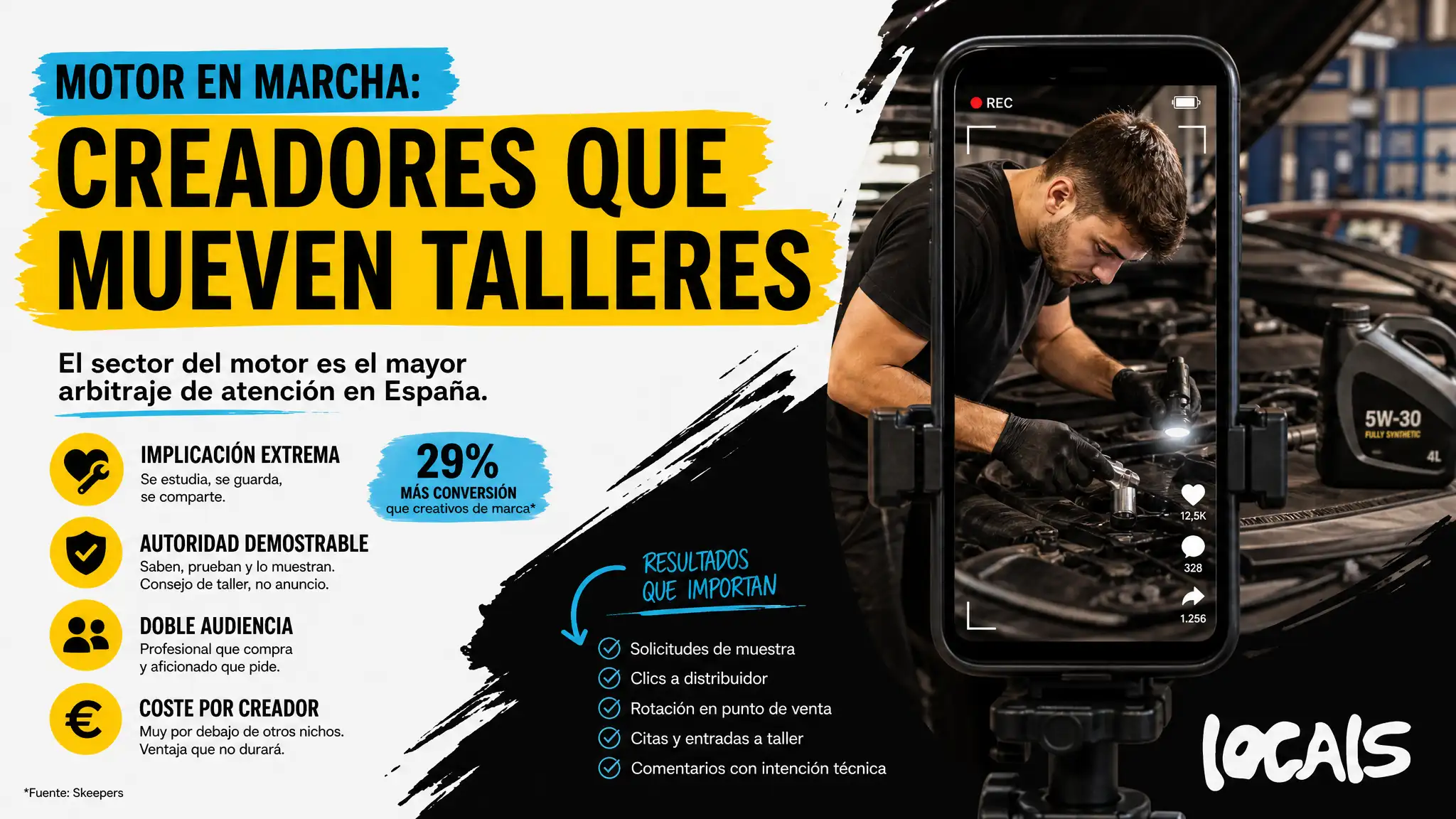
The motor sector concentrates thousands of creators in Spain: mechanics, tuners, classic car restorers and DIY enthusiasts who publish consistently, achieve very high retention and move audiences that buy in volume and come back every month. Almost no brand of parts, oil, tools or chemicals works with them systematically. It is the biggest arbitrage of attention still open in the Spanish market today.
Why No Brand Is Doing It Yet
The answer is not that it has been tried and failed. It is that almost nobody has tried, and the reasons are structural.
The distribution channel absorbs the budget. A lubricant or parts brand does not sell to the driver: it sells to the distributor, and the distributor sells to the workshop. The marketing budget goes where the contractual customer is, on rebates, trade fairs, catalogues and sales training, not where the real demand is. The workshop decides which brand to order; the brand talks to the warehouse.
The second brake is the myth of a sector that is "not visual". It is exactly the opposite: a teardown, an open engine, a before and after of a cylinder head, an injector clean are content with extraordinary retention. What is not visual is the PDF catalogue.
The third is the fear of losing technical control. Automotive marketing is trained so that every claim passes through engineering, and the idea of someone filming on their phone and saying whatever they think creates paralysis. It is a legitimate fear, and a manageable one, but it still closes doors.
Finally, the confusion between creator and influencer. When a marketing director in the sector hears "influencer", they picture an unboxing with music. They close the door there, and rightly so: that is not what they need.
The Three Properties That Make This Vertical Unique
Motor communities combine three characteristics that almost no other niche has at once.
Extreme involvement. These videos are not watched, they are studied. A repair tutorial gets watched in full, saved and shared over WhatsApp with a workshop colleague. The save is not vanity: it is intent to use later. According to data from Skeepers, campaigns that integrate creator content generate up to 29% higher conversion rates than those based on brand creative, and that advantage is amplified when the audience is professional or semi-professional.
Demonstrable authority. The motor creator is not someone you want to look like: they are someone who knows, and proves it on camera, with the product in hand and the result in view. Their recommendation works like advice from a colleague in the workshop, not like an ad.
A double audience. The same content reaches the professional who buys in volume and the enthusiast who does their own maintenance and then asks for that part number at the counter. A single campaign activates two different kinds of demand.
To that you can add a fourth factor that will not last: the cost per creator in these niches is well below what is paid in lifestyle or fashion, because nobody is competing for them yet.
Who the Motor Creator Is
They do not need to be a qualified mechanic. They need to be credible doing what they show.
- Mechanics and workshops who film real repairs: maximum technical authority and a professional audience.
- Tuners and performance builders: high involvement, a young audience and a sustained volume of content.
- Classic car restorers: narrative format, very high retention, a perfect fit for chemicals, paints, consumables and precision tools.
- DIY enthusiasts: the person changing their own oil on a Saturday is the end consumer and the best advocate for the retail channel.
- Sub-verticals (off-road, 4x4, motorbike, agricultural): their own community, and brands almost entirely absent.
What does not work is the big generalist channel that accepts a sponsorship and mentions the product for thirty seconds. That is expensive advertising in video format.
💡 Selection criterion: A workshop with 8,000 followers that genuinely repairs converts more than a channel with 500,000 that accepts any collaboration. Technical credibility beats raw reach in this niche.
One-off Sponsorship Versus a Creator Campaign
| Concept | Sponsoring a big channel | UGC campaign with creators |
|---|---|---|
| Volume | One piece, one moment | 20-40 pieces a month, sustained |
| Reach | Concentrated | Distributed and algorithmic |
| Message | Talks about the brand | Shows the product working |
| Cost per piece | High | Low |
| Reuse | Difficult | Assets ready for paid, product pages and distributors |
| Main metric | Views | Trials, leads, stock rotation at point of sale |
Thirty workshops and enthusiasts using the same oil in thirty different videos over three months is not an image campaign: it is massive, distributed social proof, and on top of that a bank of assets that feeds paid media, product pages, sales training and point-of-sale material.
For a workshop chain the mechanism is the same but the goal changes: not to sell a product but to build trust at local scale. The sector's problem is not price, it is the driver's distrust of the workshop. And that distrust is not solved with a radio ad: it is solved by seeing someone real explain what they did to the car and why.
How Do You Measure a Creator Campaign in Automotive?
Views are the toll, not the result. The metrics with real meaning are physical and traceable:
- Sample or product trial requests. The most direct indicator of purchase intent.
- Clicks to the distributor locator. "Where to buy" generated from the content.
- Part number rotation at point of sale. If the distributor shares sell-out data, attribution is almost clean.
- Bookings and workshop visits (for chains). The exact equivalent of the queue at the door.
- Comments with technical intent. One comment asking for the exact part number is worth more than 100,000 impressions.
The result that matters is the part number the workshop asks for by name, not the reach of the campaign that produced it.
How to Start Without Losing Technical Control
The balance between authenticity and precision has a simple solution: the brand sets the data and the non-negotiable claims in the brief; the creator decides the format and the narrative. The draft is reviewed before publishing, with one round of changes. That unblocks the internal fear without sacrificing the credibility of the content.
The practical recommendation for an aftermarket brand is to start with a single part number and a single sub-niche, choosing a product with a clear visual demonstration. Not the whole brand, not the whole catalogue: one concrete bet that can be measured cleanly.
Usage rights should be negotiated from the first contract. That content is going to live in paid media, product pages, sales training and point-of-sale material: it is worth far more than the original video.
The sector has spent twenty years paying for attention at trade fairs while its best community of advocates published for free. That arbitrage is running out of time.